Why Conversation in German for Beginners Feels Impossible (But Isn't)
Your brain freezes in German conversations not because you're bad at German, but because of how you've been trained. Here's how to fix it.
Published February 14, 2026 · By Nuru HasanovImagine you're at a small cafe. Someone asks, "Wie heisst du?" You know the answer. You've practised it. But your mouth freezes. Your brain seems to slow down. You can see the right words in your head, but they don't come out.
This is why conversation in German for beginners feels so hard. And the truth might surprise you: the problem is not that you are bad at German. The problem is how your brain is being trained.
Let's break it down in a very simple way.
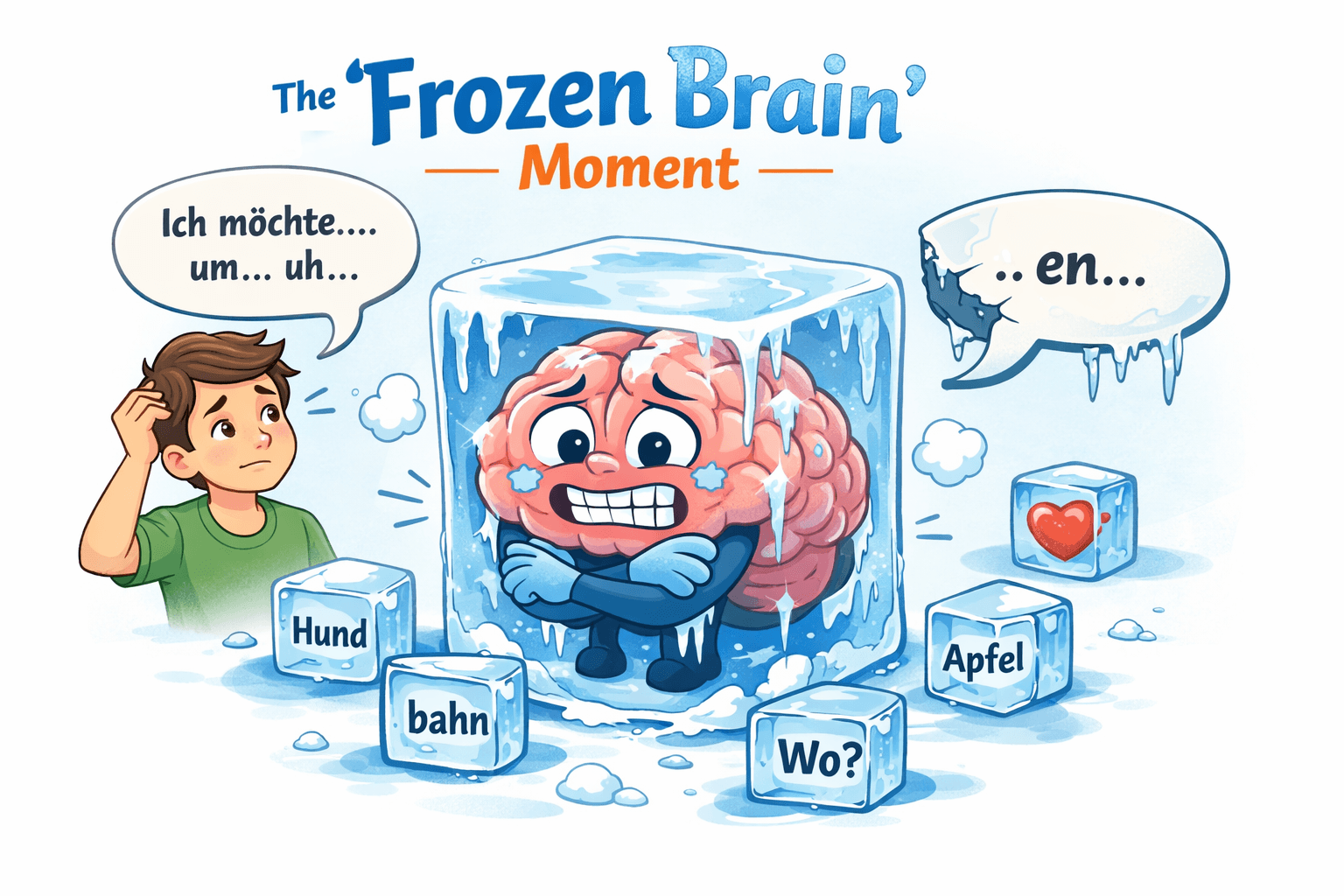
Why your mind goes blank in real conversations
Most beginners learn German in pieces.
- A list of vocabulary
- Grammar rules
- Exercises where you choose the correct answer
This teaches your brain to recognize German, not to produce it.
Think of it like this: you can recognize a song when you hear it, but that doesn't mean you can sing it on the spot.
Speaking is a different skill.
When a real conversation starts, your brain must:
- Understand the question
- Choose the right words
- Put them in the right order
- Say them out loud fast
For beginners, this is a lot at once. German grammar (verb position, cases, genders) adds even more pressure. So your brain chooses the easiest option: silence.
That's why conversation in German for beginners feels impossible, even when you "know" the language.
The hidden mistake most beginners make
Here is the biggest mistake: trying to invent sentences from scratch every time.
Native speakers don't do that. Successful learners don't either.
Instead, they build a bank of ready-made replies and short "scripts" they can use automatically. This reduces thinking time, cuts hesitation, and keeps the conversation moving.
The simple fix: build a "conversation base"
Instead of learning hundreds of words, start with 6 basic conversation answers that you can use anywhere.
Here are examples you can copy:
- "Ich heisse Alex."
- "Ich komme aus Pakistan."
- "Ich lerne Deutsch."
- "Ich arbeite als Student."
- "Ich spiele gern Fussball."
- "Ich lerne Deutsch fur die Arbeit."
These sentences are not exciting — and that's good.
Your goal is not creativity. Your goal is automatic speaking.
How to practice conversation (10-15 minutes a day)
This is a beginner-friendly routine that actually works.
Step 1: Speak out loud
Read one sentence. Close your eyes. Say it again without looking.
Speaking out loud trains your brain differently than silent reading.
Step 2: Use fake conversations
Ask yourself questions and answer them:
- "Wie heisst du?" → "Ich heisse Alex."
- "Woher kommst du?" → "Ich komme aus Pakistan."
This feels silly — but it works.
Step 3: Use a timer game
Set a 60-second timer. How many of your sentences can you say without stopping?
This builds speed and confidence.
Step 4: Accept mistakes
If your sentence is simple but understandable, it is good German.
Perfection comes later.
Strategies that actually make speaking easier
Work with a partner
Practicing with someone who gently corrects you helps corrections stick. Feedback in real conversations accelerates progress more than solo practice.
Use scripts from day one
Prepare short dialogues for common situations: introducing yourself, ordering food, asking for directions. Replay them aloud, tweak them, and gradually expand.
Talk about what you love
Conversations flow when you discuss topics you care about: sports, music, hobbies, work. Learning topic-specific vocabulary makes real-life talk easier and more natural.
Use writing or chat as a bridge
If speaking feels impossible, try live text or voice messages. This gives extra thinking time while still practicing real communication, before moving fully into speech.
Mirror and record yourself
Speak in front of a mirror or record short answers. Listening back reveals hesitation points and helps you improve pronunciation, timing, and confidence.
Leverage time markers and linking words
Even with limited grammar, you can express meaning clearly. Use words like gestern, heute, morgen and linking phrases like also, weil, dann to connect ideas naturally.
What beginners should stop doing
- Stop translating every word in your head
- Stop waiting until your grammar is "perfect"
- Stop avoiding conversations
You don't need better grammar first. You need more speaking reps first.
Final encouragement
Feeling stuck in German conversation does not mean you are failing.
It means you are at the exact stage where speaking practice matters most.
Start small. Use ready-made sentences. Speak every day, even alone.
In a few weeks, you'll notice something powerful: your brain won't freeze anymore.
And that's when conversation in German for beginners finally becomes real conversation.